Table of Contents
Language models got their training data for free, as a byproduct of thirty years of people talking online. Robots got nothing, and an entire industry is now building the missing internet by hand. What follows is where the data went, who is manufacturing it, and what it costs.
A modern language model trains on about fifteen trillion tokens of text. Suppose you read at fifteen thousand tokens an hour, which is fast. Getting through the training set would take you a billion hours, or about 114,000 years. That is the pile of experience a language model gets to learn from before it ever answers a question.
Now count the other side. The four best-known robot manipulation datasets, added together, hold about 4,400 hours. If you pool every public robot dataset on earth, you get a few years of experience. Not a few thousand years. A few years, total, for the entire field.
For scale: a child who turned two this morning has been awake for roughly 8,800 hours. Every one of those hours arrived with vision, touch, balance, and force feedback, all synchronized, and every one was generated by her own attempts to do things: grab the spoon, drop the spoon, grab it again. That toddler has more manipulation experience than the published output of the entire field, and her data is better labeled, because she always knows what she was trying to do.
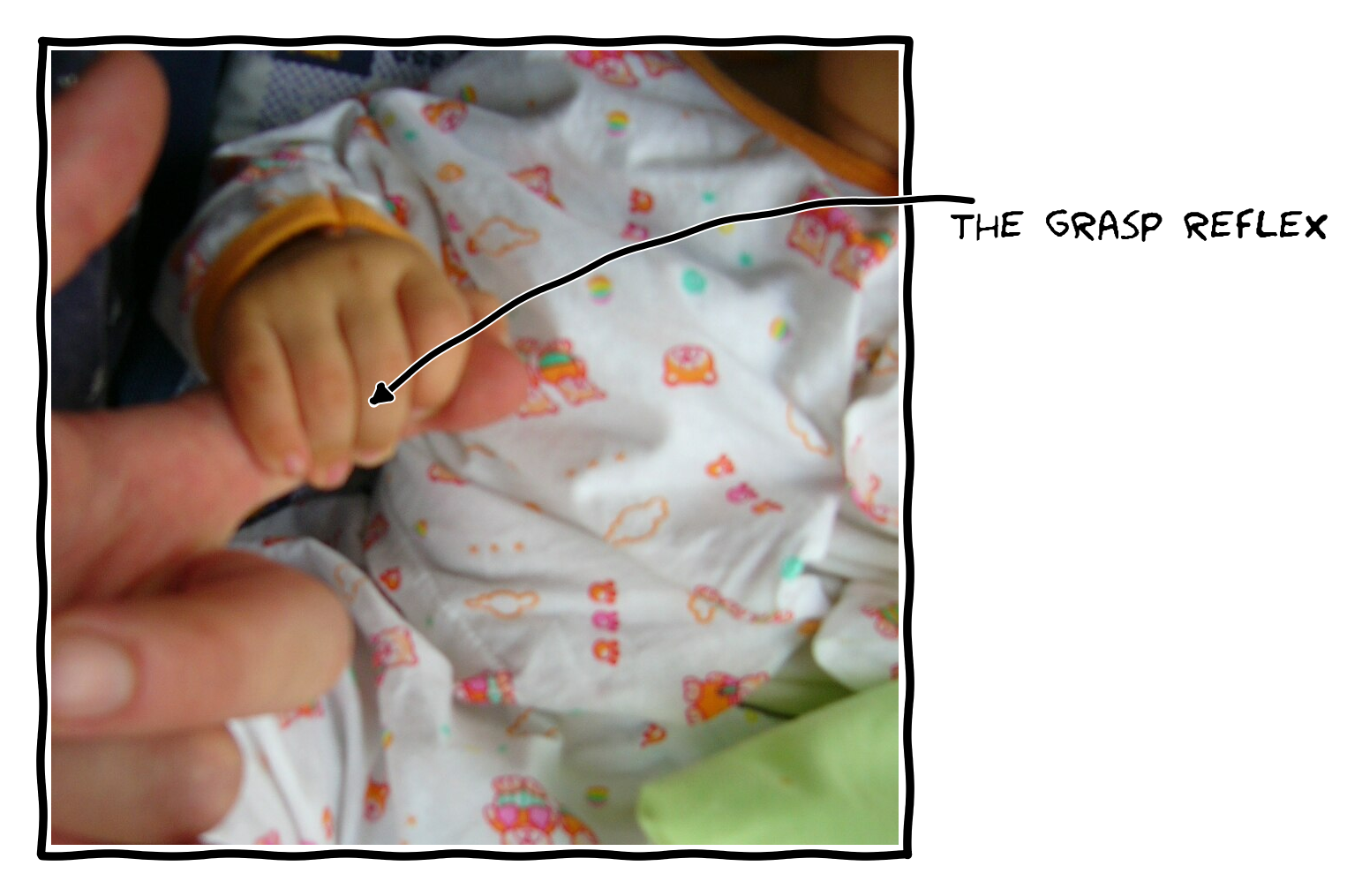
The grasp reflex. Force, slip, and vision on one clock, every hour labeled by intent.
So robots are short about five orders of magnitude of training data. Everything else, the factories, the instrumented gloves, the real-estate deals, the ten-year argument between the field’s two most credible people, follows from attempts to close it.
Cars look like a counterexample. Tesla has been collecting fleet data for a decade. BYD’s God’s Eye system entered this year on 2.3 million vehicles recording, by the company’s own figure, 160 million kilometers a day; by May the company was claiming 3.15 million vehicles and 200 million kilometers. The smaller of those figures already works out to about 170,000 years of driving experience per year, which is more than the written internet, collected annually, by one carmaker. If experience is what robots need, hasn’t the problem already been solved?
It has been, for driving. A decade of data at that scale taught machines to drive themselves across ninety cities. And none of it, not one kilometer, has taught any machine to load a dishwasher. The reason is what the data contains. Driving data has cameras, steering angles, and pedal positions. It has no hands. It has no grip force, no contact, no record of fingers closing around anything. The action space of a car is two pedals and a wheel, and manipulation lives in a different space entirely.
The shortage has a specific shape: robots lack contact, records of hands touching things and of what happened next. The internet never collected that, because nobody types their grip force into a keyboard. The car fleets never collected it, because cars do not have hands. It has to be manufactured, from scratch, at industrial cost, and the price of manufacturing it explains most of what this industry currently looks like.
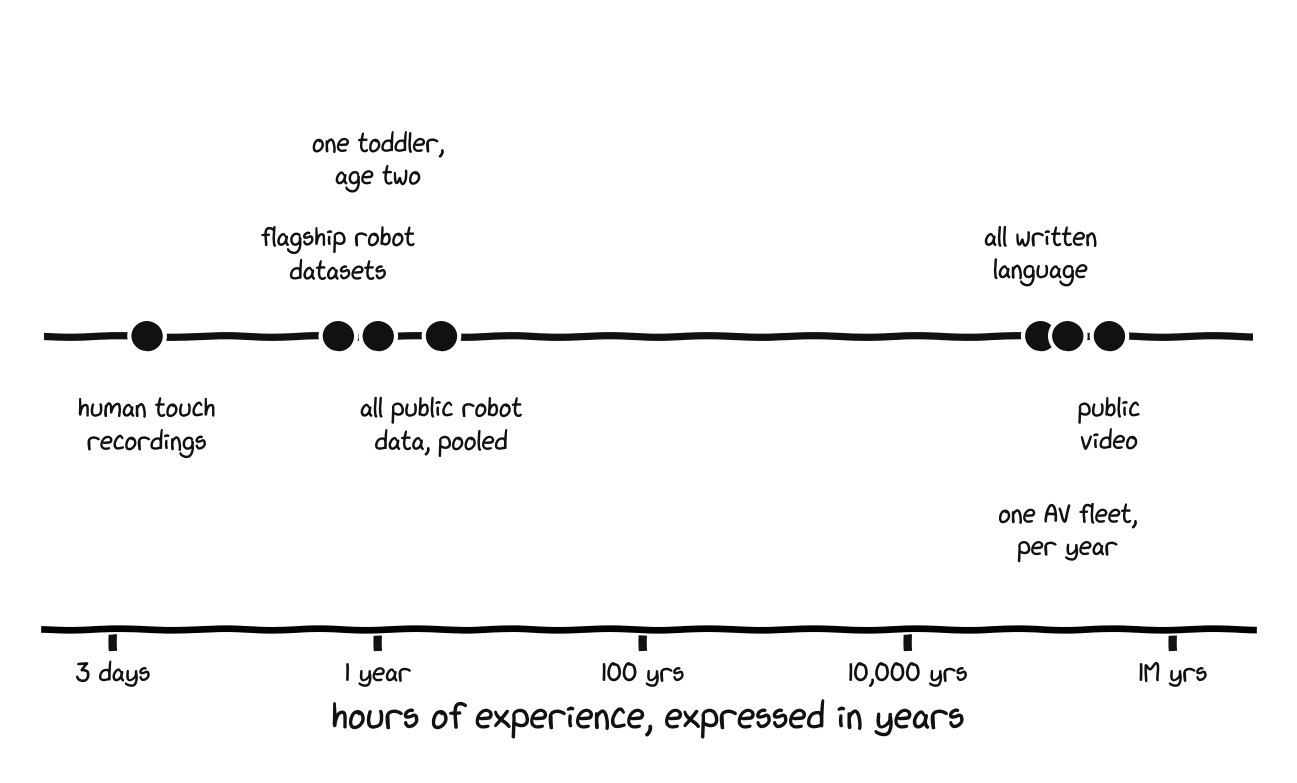
Experience available for training, in years. None of the biggest bar transfers to hands.
what the robots inherited
Robots did get something for free, and it is substantial. Put a current robot in front of a kitchen counter it has never seen. It will identify the red object as a mug. It knows mugs have handles, that the handle is where you grip, and when you say “put the mug in the sink,” it resolves that sentence to this particular mug and that particular sink. None of this came from robot experience. It came from internet text and images, by way of a vision-language model, and it is the reason nearly every serious robot today carries a VLM at the top of its control stack. The knowledge was free because the internet already contained it. Thirty years of people photographing mugs and writing about mugs turns out to transfer.
But the inheritance has a hole in it, and the hole is spatial. Frontier vision-language models, the same ones that can explain a physics paper, confuse left and right at rates that would embarrass a five-year-old. The reason is in how the training data was written. Apples are red in millions of sentences, written by millions of people, and they all agree, so color survives the trip from text into the model. But “left” and “right” get written from wherever the writer happened to be standing. The mug is left of the sink from your side of the counter and right of it from mine. The training data contradicts itself millions of times, so the concept never sets. Precise 3D position from a single image is unreliable for related reasons.
And a manipulation command is almost nothing but relative positions. “Put the mug in the sink” reduces to two of them: where the mug is with respect to the hand, where the sink is with respect to the mug. So the model at the top of the robot’s stack knows exactly what a mug is and cannot be trusted about where the mug is.
touch
Touch never entered the inheritance at all. A camera cannot measure force. From the outside, a grasp that will hold an egg and a grasp that will crush it look identical, because the variable that decides between them, pressure at the fingertips, does not show up in pixels. And people run almost the entire hand repertoire on exactly that variable. Checking whether fruit is ripe. Holding a greasy pan. Feeling that a key needs a wiggle before it turns. All force, no vision.
How much touch data exists? The largest recorded datasets of human touch, collected with instrumented gloves, top out at around one to two hundred hours across a few hundred tasks. Text got a billion hours; touch got a hundred and change. Temperature, vibration, and slip sensing exist as hardware and have effectively no data behind them. Smell and taste are further gone still: no standard sensor, no file format, no training objective. In thirty years of the internet, nobody has uploaded a smell. Even pain, in the plain engineering sense of a channel that reports damage to the body, is standard equipment in every animal and absent from almost every robot.
The hardware is as stuck as the data, and it has been stuck for a while. In 2017 Rodney Brooks wrote down what a general robot hand would require: progress in mechanisms, durable skin, embedded sensors that survive years of impacts, the ability to adjust a grasp mid-motion, and pregrasp planning from vision. The uncomfortable part of the list is that it has to advance together. A skin material is useless without sensors that fit under it, and both are useless without a controller that can act on what they report. Factory grippers consequently still look like they did in the 1980s.
Mapping was once considered just as hopeless. It got solved because SLAM gave hundreds of researchers one crisp, shared problem to attack for twenty years. Hands never got a problem statement that clean, so no comparable army ever formed around them.
There is one live attack on the touch-data side, and it runs through prediction. Train a world model on manipulation footage so that it outputs, alongside the pixels it expects to see, the force a grasp should produce. Then at execution time, compare the measured force stream against the predicted one. The interesting event is the disagreement. If the fingers close and meet less resistance than predicted, the object is lighter than it looked, and the grip can relax before the tomato pays for the error. Tactile sensors that resolve a few grams of force are now shipping on production fingertips. What those sensors lacked until recently was a training objective, some definition of what the robot should learn from them, and predicted-force mismatch is one.
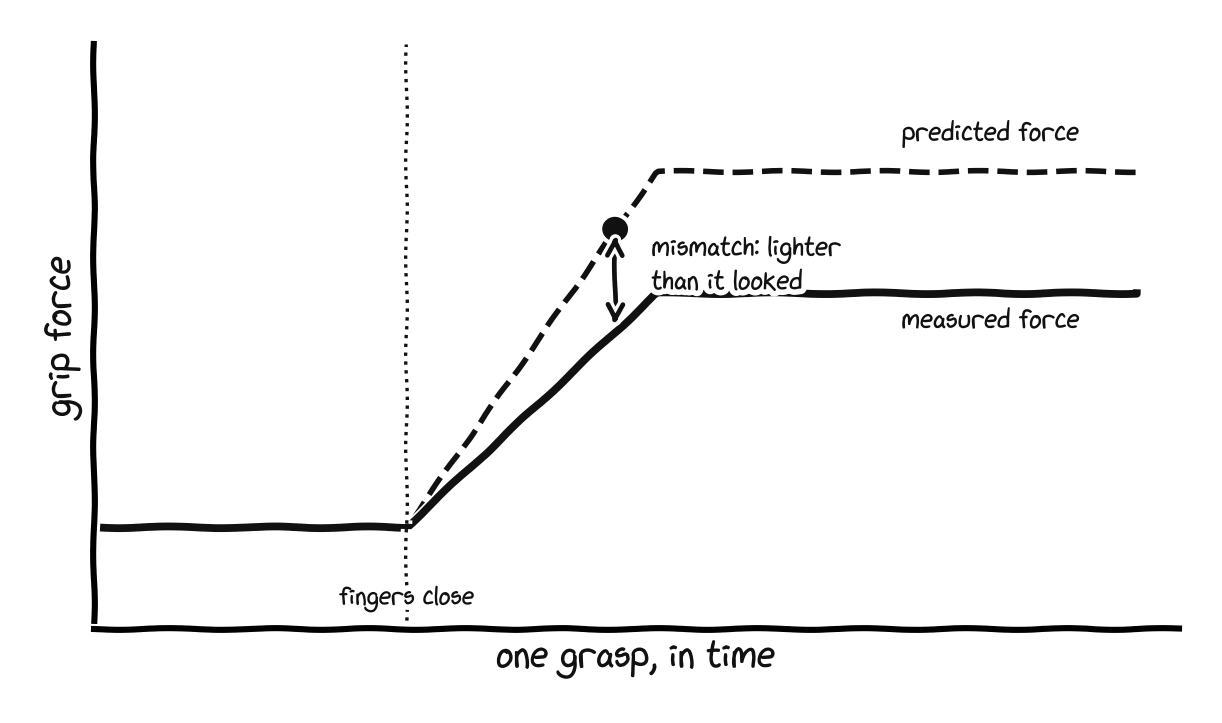
Predicted against measured grip force. The gap between the curves is the training signal.
why not just simulate it
All of this data is expensive because it has to be lived, in real time, by a body. Computers simulate everything else, so why not simulate the kitchen?
The question has a long history, and it starts with an observation Hans Moravec made in 1988: computers handled expert reasoning easily and stumbled on the physical skills our two-year-old already has. For decades this was filed under paradox. Price it in data and the paradox dissolves. A chess program can generate unlimited expert games by playing itself, because the rules of chess are a complete, free simulator. No process generates sandwich-making attempts. Each one costs real time in a real kitchen with real bread. Skills fell to machines in order of how cheaply their experience could be manufactured, and that ordering has held from chess through Go straight into the present.
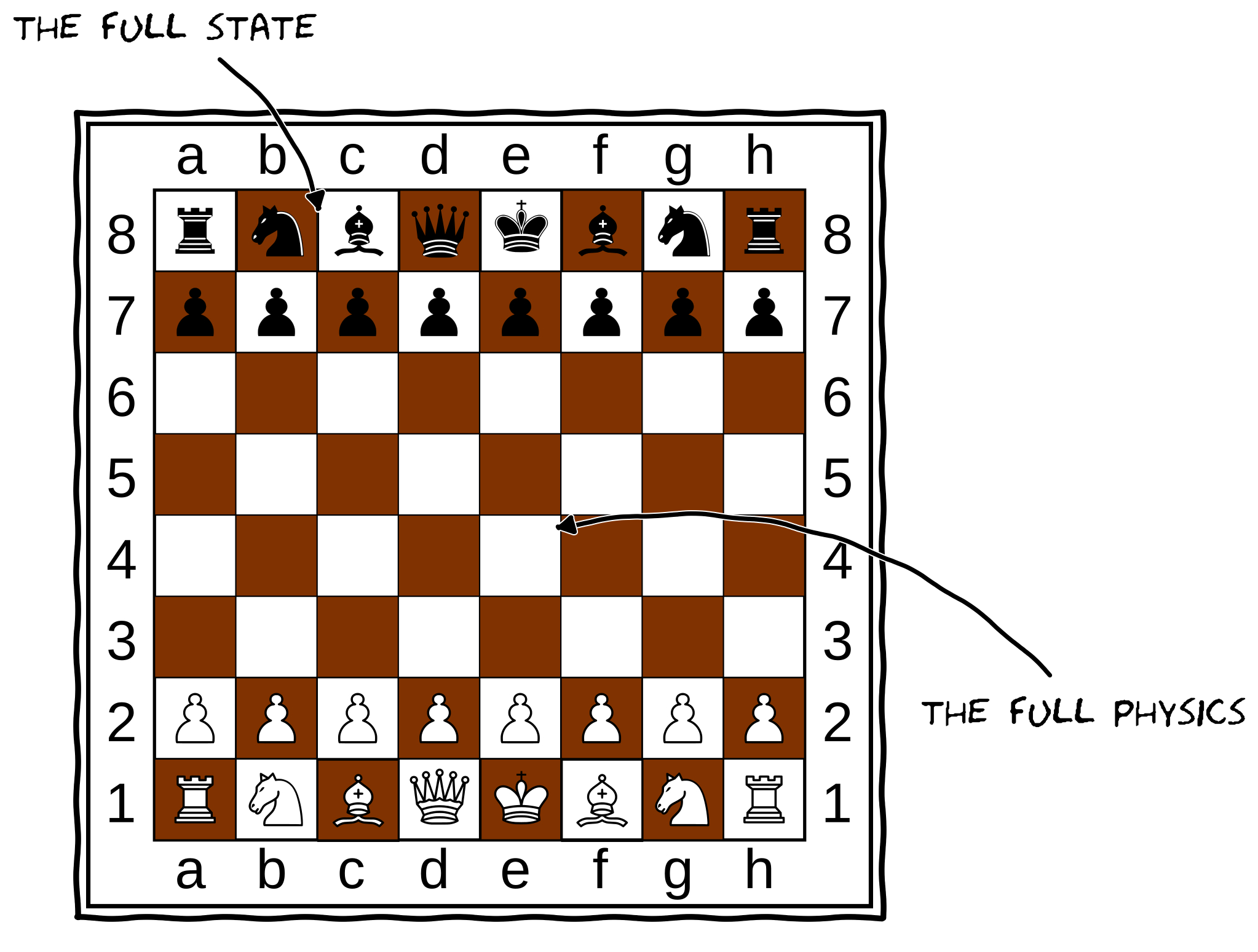
The rules of chess are a complete, free simulator. Nothing generates sandwich-making attempts.
The field already does simulate, wherever the physics engine can be trusted, and walking is the success story. Rigid-body physics, meaning masses, joints, and hard contact, has been computed accurately for decades, so a walking simulator can be trusted. Figure trained its balance controller in about 200,000 simulated environments running in parallel, with terrain, friction, and payload randomized so widely that the real world sits somewhere inside the training distribution, and the policy transferred to hardware without any real-world fine-tuning. Simulation also quietly removes the two constraints that make real-robot learning slow. A 60-kilogram machine gets to practice falling, which no building’s insurance permits in the real world. And the simulator reports every internal variable at every timestep, where a real task reports success exactly once, at the end, and only if someone was watching.
Then you reach for a towel and the whole approach comes apart. Contact between non-rigid things breaks the engines. Friction depends on surface detail finer than any mesh. Cloth, cardboard, and food deform in ways the solvers handle slowly and wrongly. A policy trained on simulated towels picks up habits that are subtly off on real towels, and the diagnosis gets billed in real-robot hours, which were the expensive thing you were trying to avoid. This is the specific reason locomotion got solved in simulation and manipulation did not.
The engines are improving fast enough that the description needs a date on it. As of now: the current generation runs as compiled GPU kernels, hundreds of times faster than two years ago on manipulation scenes. The Newton engine precomputes a signed-distance field for each collision mesh and resolves contact as a distributed patch instead of a fictional single point, so soft surfaces press instead of click. Coupled solvers can step a rigid robot and a deformable cable in one simulation, trading forces every timestep. And several engines are now differentiable, meaning gradients flow backward through the physics itself, which lets a lab fit friction and stiffness to reality from a handful of real trials and improve a policy through the dynamics directly. Real limits remain: cloth and liquid are unsolved, and gradients through long rollouts cost memory that has to be rationed. The fair summary is that simulated contact is getting cheaper every year and is not yet trustworthy in the exact regime where manipulation lives.
the machine itself
Simulation bought walking, and walking put a computer on the robot’s back.
A walking biped is a falling object that catches itself a thousand times a second. Its balance controller runs at 1,000 Hz, and each correction has to arrive within about a millisecond. No wireless network on earth promises milliseconds, and no safety case is allowed to assume connectivity, because the robot has to remain safe at the precise moment the building’s wifi dies. So the control stack cannot live in the cloud. It rides the robot, on a battery, inside a power budget of roughly 40 to 130 watts.
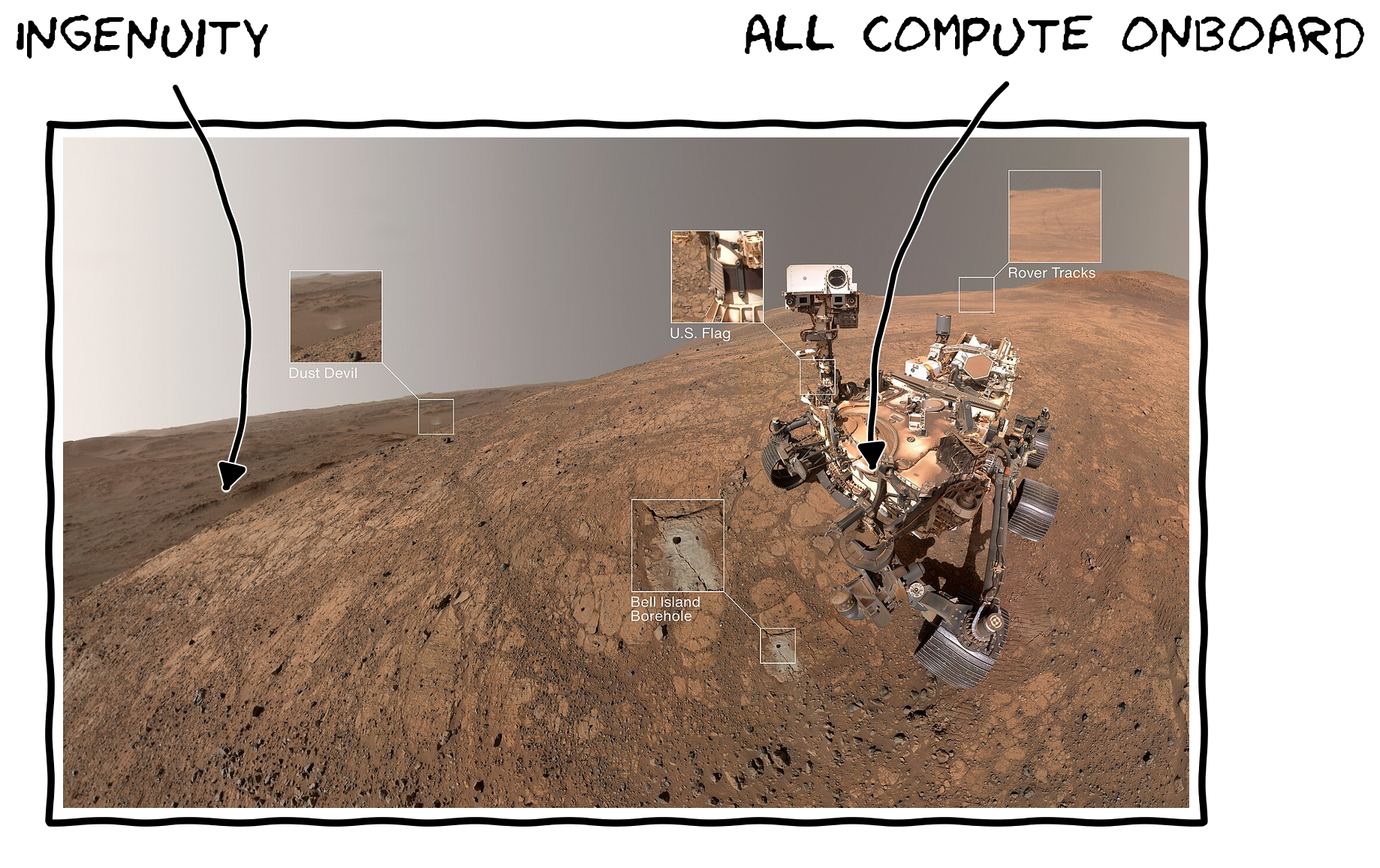
The far end of onboard autonomy: the round trip to the operators is measured in minutes.
The standard part for this job is NVIDIA’s Jetson Thor: about 2,000 teraflops at 4-bit precision, 128 GB of memory, inside that power envelope. Those teraflops sound like plenty, and they are not the constraint. The constraint is memory bandwidth. Thor moves 273 gigabytes per second, against roughly 3,350 on a datacenter H100, and producing one output token from a language model requires reading every weight in the model once. Run the division yourself. A 7-billion-parameter model at 8-bit precision is 7 GB. 273 divided by 7 is 39, so the chip can manage at most 39 forward passes a second, and that is before the cameras, the attention cache, and everything else on the robot take their cut of the same memory bus. Figure’s deployed vision-language model runs at 7 to 9 Hz, comfortably below its own theoretical ceiling, for exactly that reason.
Datacenters face the identical limit and beat it by batching: one read of the weights serves dozens of users at once. A robot serves one user, itself, and cannot batch. So every parameter added to the onboard model is paid for twice, once in response rate and once in battery minutes.
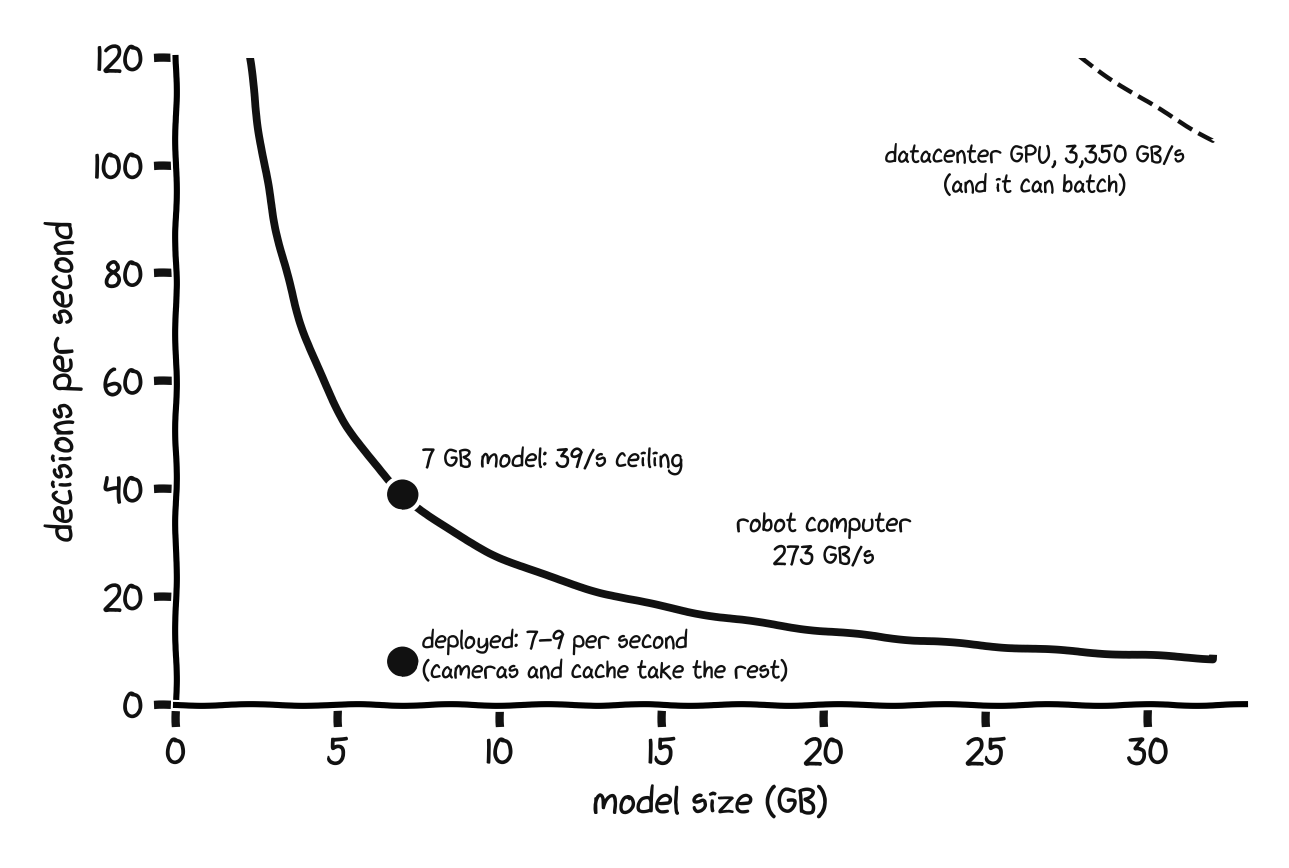
Decisions per second at 273 GB/s. Deployment sits below the ceiling; perception shares the bus.

The whole onboard computing problem in one inequality.
The battery half of the budget has a control-theory history that the spec sheets skip. Honda’s ASIMO walked by using high-gain feedback to override the machine’s natural dynamics at every joint, and it burned roughly twenty times the energy of a human walking the same distance, adjusted for weight. At the other extreme sit passive dynamic walkers, machines with no motors and no computer at all, which walk down shallow slopes with eerily humanlike gaits, because a well-shaped pair of legs does a large fraction of walking on its own. Russ Tedrake’s underactuated robotics program has spent two decades on the project implied by that contrast: controllers that exploit the body’s dynamics instead of fighting them. The five-hour battery on current humanoids is partly a measure of how far that project still has to go. For calibration, a human brain runs the entire animal on about 20 watts. The robot spends up to 130 watts on thinking alone and pays the motors separately.
All of this follows from one design decision: legs. A biped falls continuously, which forces the millisecond loop, which forces onboard compute, which invokes the bandwidth ceiling and the battery tax. Take away the legs and the chain breaks. A wheeled base is statically stable. It can stop and wait when the network hiccups, which means its brain can live in the cloud on a thin client, which deletes the onboard computer and most of the machine’s cost. That deletion is how a two-armed mobile manipulator reached a retail price of 1,288 dollars this year.
Given all these constraints, nobody runs a single model. Figure’s stack is representative: a 10-million-parameter network at 1,000 Hz handling balance and contact, an 80-million-parameter network at 200 Hz mapping sensors to joint commands, and the 7-billion-parameter VLM at 7 to 9 Hz deciding what the task even is. Each level trades roughly a hundred times the parameters for ten to twenty-five times less frequency. The question of whether one big model could do it all end to end was settled by Google’s RT-2 in 2023: 55 billion parameters drove a robot at 1 to 3 Hz, far too slow to be anyone’s only brain, and the dozens of published stacks since have all split fast-small from slow-large. Training happens in a datacenter, new weights reach the fleet over the air every few days, and torque commands never cross the network in either direction.
who is paying for all this
Someone is writing the checks for all of this, and the check-writing starts with an ugly fact about warehouse work. Amazon loses about 3 percent of its warehouse workforce every week. Compound that and it comes to over 150 percent a year. Whole cohorts quit inside their first seven days. In several metro areas, the company has already employed and lost most of the people within commuting distance who are willing to take the job at all. Recruiting, onboarding, training, and a floor permanently staffed with first-week employees add about 56 percent on top of the sticker wage, so a 20-dollar-an-hour job costs the employer about 31, and fully loaded warehouse labor in the United States runs 30 to 45 dollars an hour.
Against those numbers, Agility rents its Digit humanoid at a flat 30 dollars an hour, claims payback inside two years, and, in a nice piece of framing, bills it as labor rather than equipment. The model has enough traction that in June the company filed to go public through a 2.5-billion-dollar SPAC, the first American pure-play humanoid maker to list, on the strength of more than 65,000 hours of paid commercial operation. That keeps the robot off the capital budget and inside a site manager’s signing authority, with the downtime risk sitting on the vendor. The robot is priced against the loaded cost of a human who will probably quit next week.
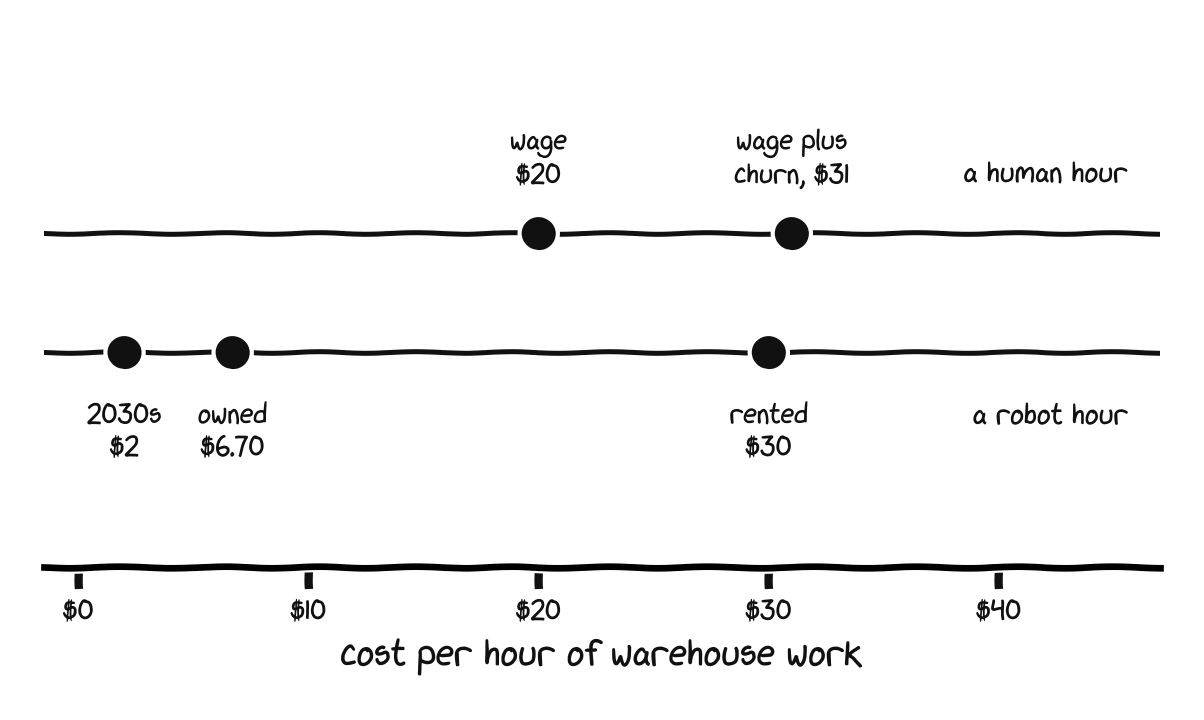
Warehouse work, per hour. Digit rents at the loaded human rate; owned, about 6.70.
Between a working robot and actual revenue sit two gates, and both are stricter than the demo videos suggest. The first is safety certification. Digit passed an OSHA-recognized third-party field safety inspection at a live customer site in November 2025, the first humanoid to do so, and the gate matters because a machine that cannot pass cannot be insured, and an uninsurable machine does not get deployed regardless of how capable it is. The second gate is quieter: operators filter work at the item level. About a quarter of Amazon’s catalog sits on exclusion lists that robots may not attempt, with items added after as few as five to ten failed test picks. So every published success rate for a deployed robot describes a pre-screened world.
There is a broader version of this point that the industry mostly learns the hard way. A robot that clears a benchmark in a controlled cell and a robot a customer will pay for are two different machines. The second one has to fail gracefully around untrained people, get maintained by technicians who never met its designers, honor an uptime commitment near 99.5 percent, and carry unit economics that survive at the volume the first real customer can actually buy. Nearly every headline robot is the first kind of machine. Nearly every robot currently earning revenue is the second kind, and if you go look at what the second kind actually is, it is boring: tug robots, tow tractors, floor-plan printers, many of them not autonomous at all, because a return on investment does not require autonomy. The robots making money today mostly skipped the intelligence.
Building the machines at scale hit its own wall: there was nobody to buy parts from. A carmaker assembles components from tiers of suppliers refined over a century. Humanoid-grade actuators, hands, and battery packs had no merchant market at all, so Figure designed nearly the entire machine in-house and then committed to three million actuators over four years, enough for 200,000 robots, before it had delivered its first few hundred. The line went from one robot a day in January 2026 to one an hour by the end of April, a 24-fold increase in under 120 days, achieved by swapping machined parts for die castings and injection moldings at a tenth the cost, with 80 functional tests per unit, 80 percent first-pass yield, and stated capacity of 12,000 a year on the first line and 50,000 after. Around it, the rest of the industry: Unitree sells research humanoids for under 14,000 dollars, BYD has 150 humanoid prototypes working inside its own plants, Agility sized its Oregon factory for 10,000 a year.
For scale, the world builds 90 million cars a year and installs half a million industrial arms. The entire humanoid industry is three orders of magnitude smaller than the categories it gets compared to. The sprint to close that gap is only half about selling robots. Every unit shipped is also a collector.
manufacturing the internet
The first internet accumulated as a byproduct: people talked, and the text piled up. The second one, the one made of contact, is being assembled on purpose, and as of today it has exactly five sources. Every serious lab runs all five at once, because each covers a specific failure of the others.
The first source is simulation, which we have already priced. It costs nearly nothing per hour, it labels every force perfectly by construction, and it is trustworthy exactly as far as the physics engine, which today means rigid bodies. It bought locomotion, and it contributes less as contact increases.
The second source is human video, and it inverts simulation’s trade exactly: real physics, internet scale, and no action labels at all. Footage of hands folding a shirt records no torque and no grip force. The largest position anyone has taken in this source is Figure’s Project Go-Big, built on a partnership with Brookfield, the real-estate giant, to collect first-person human video across 100,000 residential units and several hundred million square feet of commercial space. The first published result: a robot navigating cluttered homes from spoken instructions after training on human video alone, zero robot demonstrations. A real-estate portfolio became a data asset, a measure of how scarce the field considers this input.
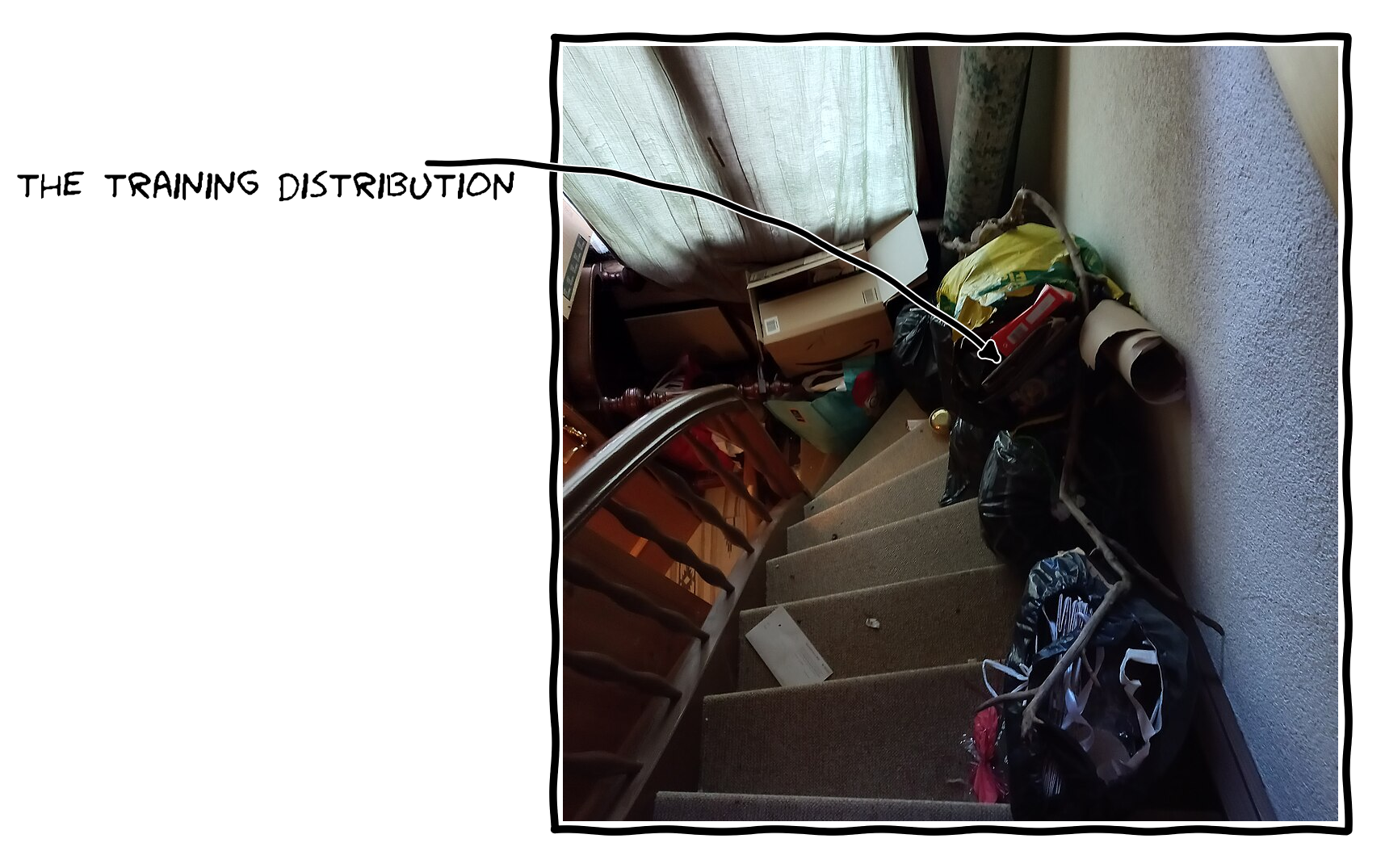
What the footage has to cover. Nobody staged these rooms.
If video has no action labels, how does watching it teach a robot to act? Through a specific piece of machinery with billions of dollars riding on it. World models currently come in three working forms. The classical form predicts the next state given the current state and an action. Planners have wanted that since STRIPS in 1971; the model was always the bottleneck, never the planning; and it needs action labels, which video lacks. The video-first form generates future video with no actions anywhere in training, and then a separately trained inverse-dynamics model looks at each pair of adjacent frames and recovers which action must connect them. That adapter is small and cheap, and it converts the internet’s dominant free modality into policy supervision. It is the mechanism underneath the Brookfield bet. The third form predicts video and actions jointly in one network, and it currently posts the best generalization numbers.
One practical detail kept video out of reach until recently: tokens. An hour of video is 108,000 frames, which at the per-frame rates chat models pay comes to 50 to 100 million tokens, and the corpora run to millions of hours. The fix is the video tokenizer, which compresses time and space together, 4x along the time axis and 8x to 16x per spatial axis in current production models, for a total of 250 to 1,000 times smaller than raw pixels. The compression works because consecutive frames mostly repeat, so the encoder only spends capacity on what changed. Training on the video internet now requires a datacenter and nothing rarer than that.
The third source is teleoperation: a human drives the robot through the task, and the robot records exact action labels in real physics. The price is a human wage per hour, and the volume shows it. About 500 hours of teleoperation trained the first version of Figure’s Helix. The learning method is behavior cloning, literally the same next-step prediction that trains language models, brought back into robotics by Diffusion Policy and by ALOHA’s action-chunking transformer. Its structural weakness comes from the fact that a robot’s actions run in closed loop with physics. The policy makes a small error, the error changes the state, the changed state produces an observation the training data never contained, and the policy is now off the map. There is also a subtler objection, due to Sergey Levine: a model trained on teleoperation learns to imitate a robot being driven by a human, and that is a genuinely different task from the task itself.
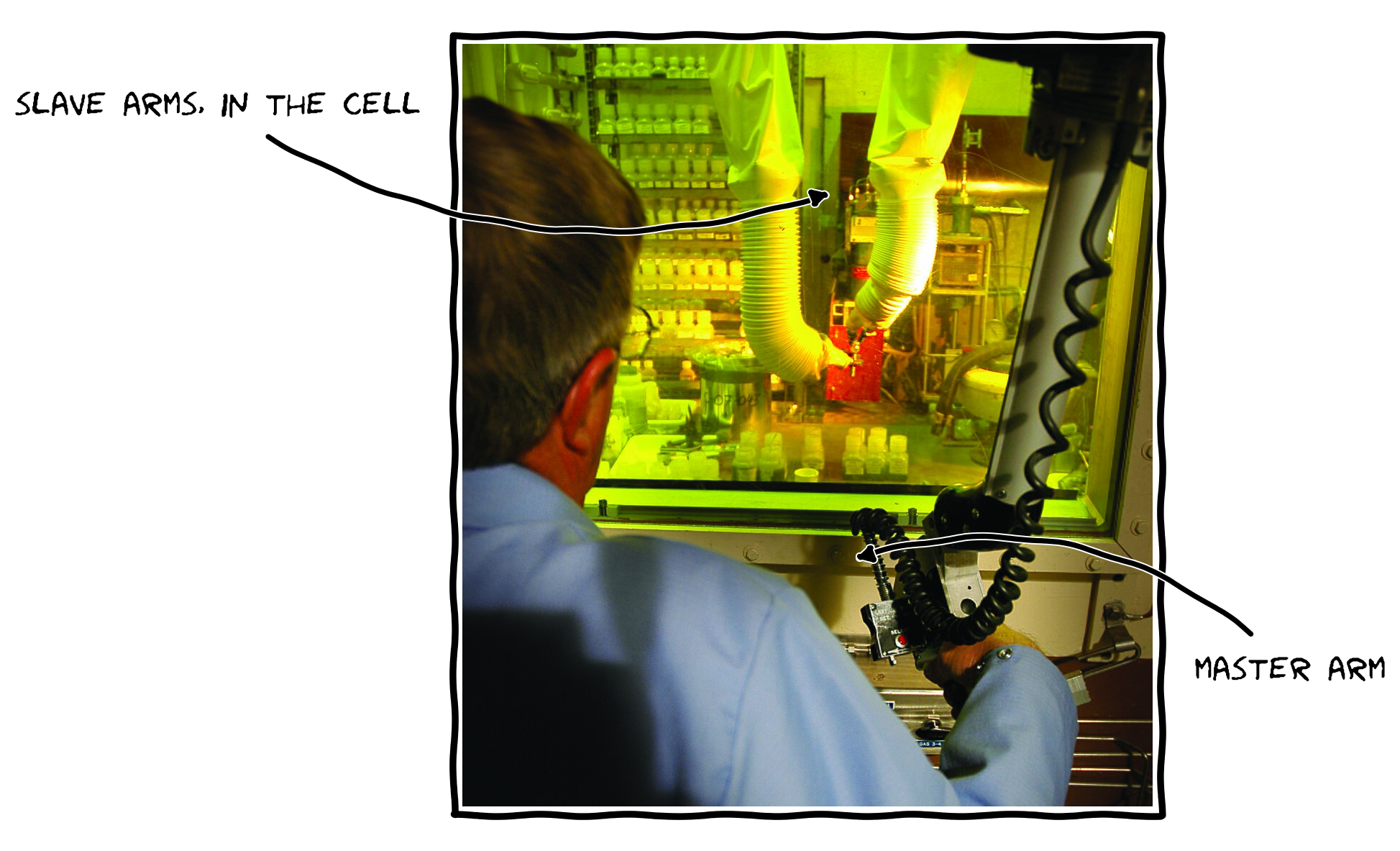
Master-slave manipulators in a hot cell, decades old. The human supplies the action labels.
The fourth source was built around that objection. Sunday Robotics makes a glove, costing a couple hundred dollars, that exactly duplicates the gripper on its home robot. A paid network of operators wears it while doing chores in their own homes: more than 2,000 gloves across more than 500 households so far, roughly ten million recorded episodes. No robot, no teleop rig. Real contact, real grasp poses, an order of magnitude cheaper per hour than teleoperation, portable to any house, and a 165-million-dollar Series B at a billion-dollar valuation behind it. The residual gap is compliance: a gloved human hand and a rigid gripper deform differently under load. That gap is smaller than video’s, because the geometry matches, and it is not zero.
The fifth source is the robot’s own deployment, and it exists because demonstration data has a ceiling built into its physics. A policy trained only on correct behavior drifts. Its first small error produces a state no demonstration covered, where it errs bigger, and the compounding caps imitation-trained policies near 50 percent task success in practice. More demonstrations move the ceiling only slowly, because the errors are the robot’s own, and only the robot’s own experience samples them. No human demonstrator ever visits the states the robot’s mistakes create. The first production-scale evidence for the fix, reinforcement learning on the fleet’s own attempts, is Physical Intelligence’s Recap results from late 2025: throughput roughly doubled, failure rates cut by half or more on the hardest tasks, demonstrated by an espresso station run continuously from 5:30 in the morning to 11:30 at night and by laundry folded in homes the robot had never entered.
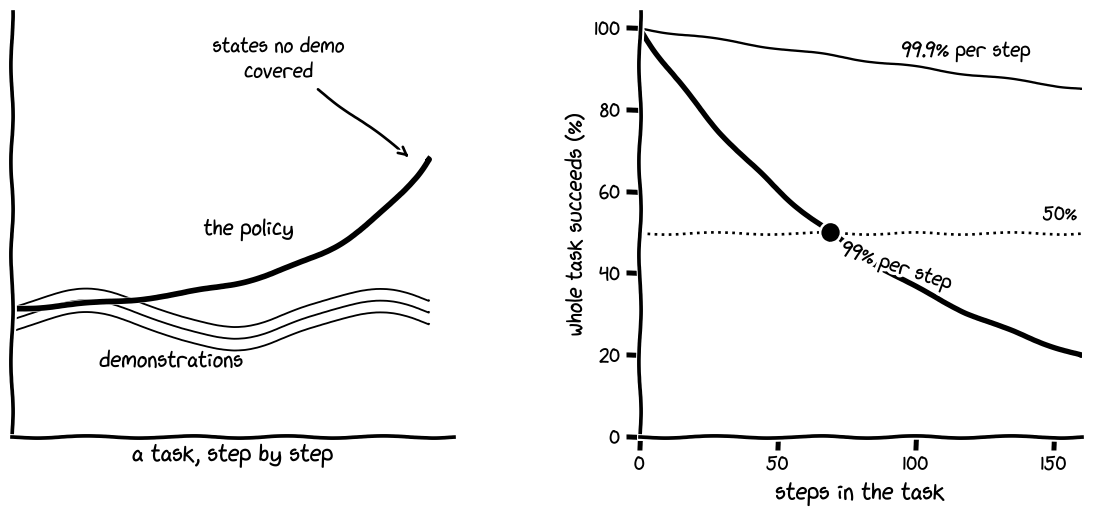
Drift into states no demonstration covered, and the compounding that caps imitation near 50 percent.
Deployment as a data source has a production logic all its own, and it explains why these companies are so desperate to grow their fleets. Once a policy is mostly reliable, progress is rate-limited by how often anyone observes a failure. Failures observed per day equal fleet size, times hours per day, times the failure rate. The trap sits right in that arithmetic: every improvement drops the failure rate, which drops the discovery rate, which means every drop has to be paid for with fleet growth just to keep learning at the same speed. Figure says this outright: the point of scaling to hundreds of units is to meet the failure modes that only appear after thousands of cumulative hours. Two corrections keep the picture honest. Robots wear out, so a fleet drags a permanent maintenance and spare-parts operation behind it. And fleet data is mostly redundant. The ten-thousandth espresso pull teaches nothing, so past a certain size the binding problem becomes finding the informative minutes inside petabytes of routine.

The fleet learning rate. Every drop in the failure rate must be bought back with fleet size.
the last time somebody made this bet
Every claim in the last section, that deployment closes the gap, that intervention rates price competence, that the fleet eventually feeds itself, was made a decade ago about cars, funded with more money than humanoids have raised, and run all the way to a verdict. The humanoid discussion rarely brings the verdict up, and it cuts both ways.
Between 2015 and 2017, essentially every major player in autonomous driving promised full autonomy by 2017 to 2019. Rodney Brooks started an annual predictions scorecard in 2018 substantially to track those dates as they failed, and they failed on schedule. Argo AI shut down with 3.6 billion dollars invested. Uber sold off its self-driving unit. The sector consolidated through a proper winter. And then the technology arrived anyway, roughly ten years behind the promises. Waymo now runs driverless service in ten cities with more than twenty announced, raised 16 billion dollars for the expansion, and delivers hundreds of thousands of paid rides a week from a fleet of about 3,000 cars. The mid-2010s claim that the last person to get a driver’s license had already been born now reads as roughly on track. So: mechanism right, schedule wrong by about a decade. That decade is the only measured base rate in existence for the kind of promise the humanoid industry is currently making.
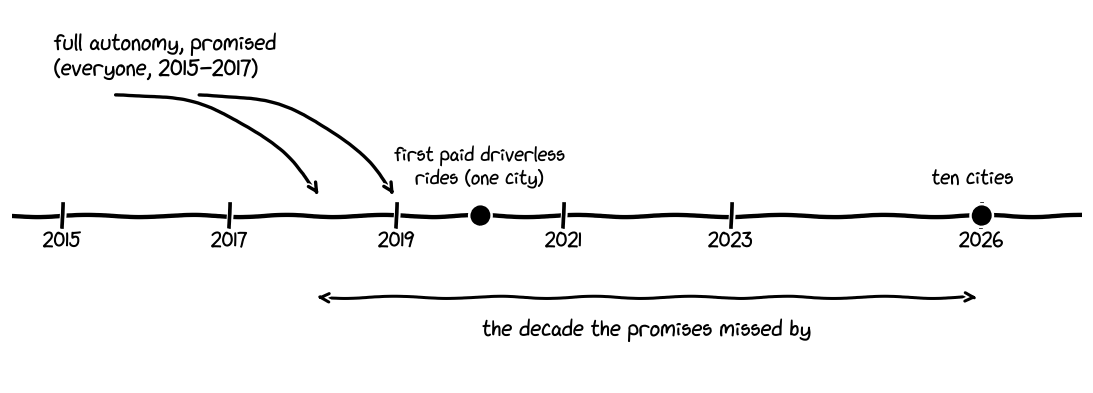
Promised against delivered, autonomous driving. The gap is the only calibration we have.
The mature version of the business teaches two more lessons. First, what good intervention economics look like: Waymo reports about 70 remote operators supporting more than 3,000 vehicles, one human per 43 robots, and the operators answer questions rather than drive. “Confirm this obstacle can be ignored.” “Take these waypoints.” The car retains responsibility for not hitting anything at all times. Current humanoid deployments run orders of magnitude hotter than that ratio, and every teleoperation contract in the industry is an implied promise to walk it down toward Waymo’s number.
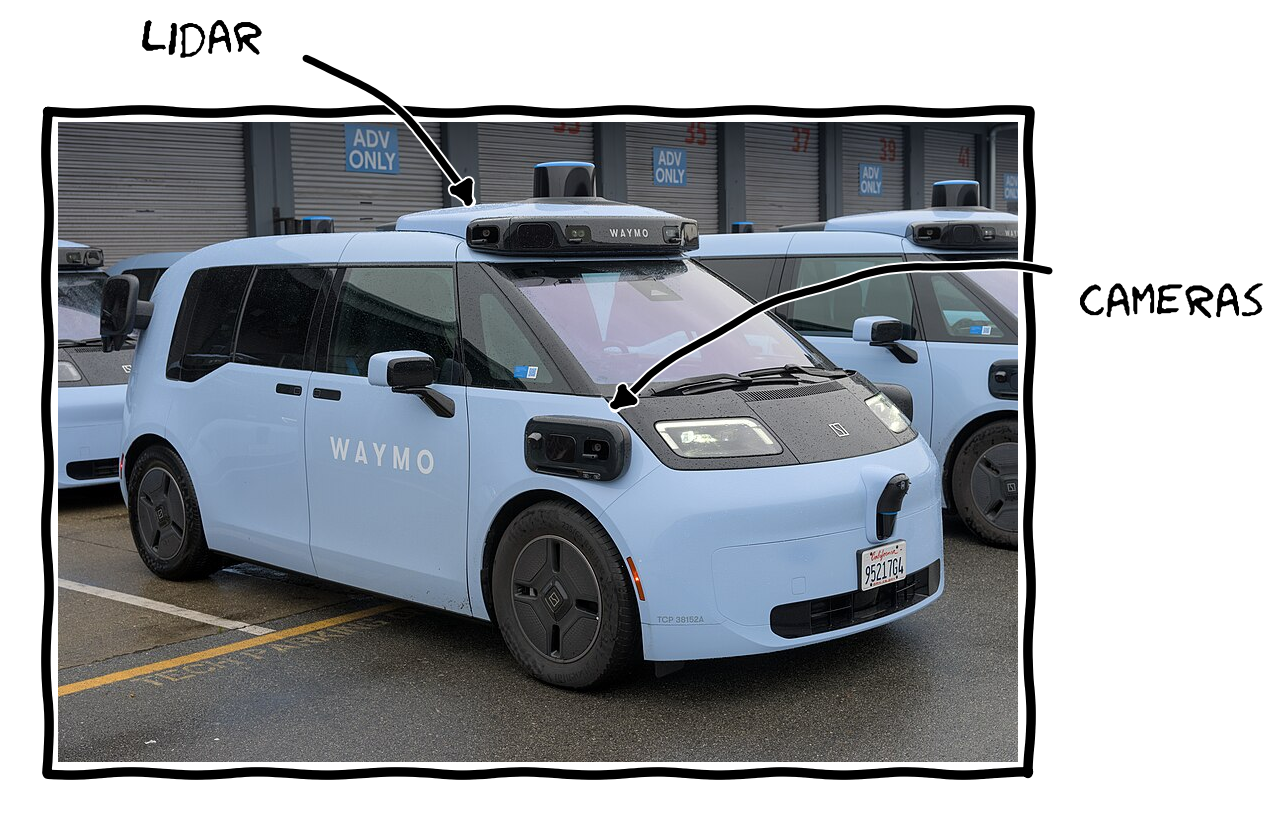
A Waymo depot. One operator per 43 vehicles, answering questions rather than driving.
Second, a failure mode nobody had priced. During the December 2025 San Francisco power outage, a substation fire knocked out power to about a third of the city and its traffic signals in one afternoon; Waymo’s own accounting says its cars had to negotiate dark signals more than 7,000 times that day. A dark intersection is negotiated socially, by creeping forward, eye contact, and waving, which is precisely the category of skill earlier sections filed under unlabelable. Confirmation requests spiked across the entire fleet simultaneously, the remote-operations queue saturated, and vehicles stalled across the city, nearly 1,600 stoppages of two minutes or more, over 60 cars moved by hand, several of them blocking emergency responders, until the company suspended service. The lesson generalizes: when one robot meets a wall, the whole fleet meets it in the same minute, city-wide. Nothing in the humanoid stack as currently built prevents the warehouse-chain equivalent.
And driving supplies one more data point, the harshest one. It is the source of the largest bar on this essay’s opening chart, the single robot modality collected at true internet scale, and ten years of it moved manipulation not at all. Wayve’s map-free driving generalized across 90 cities in 90 days and ships in Nissans from 2027, and none of it folds a shirt, because none of it contains contact. So the self-driving precedent prices the humanoid bet from both sides at once. It confirms the flywheel spins, puts the delay at about ten years, supplies the intervention ratio to aim for and the correlated failure to fear, and shows that scale in the wrong modality buys nothing across the gap. Skeptics append a coda: cars were the easy case, one vehicle class, a rulebook, no dexterity, and the easy case still slipped a decade.
nobody can keep score
A verdict needs a scoreboard, and robotics does not have one. Image classification got ImageNet because classifying is one-shot and non-interactive: show the model a photo, get a label, compare against the answer key. A frozen dataset can therefore grade any model, forever. A robot policy does not work like that. It acts in closed loop. Its errors change the world, the changed world produces observations the dataset never contained, and a good policy is defined precisely by how it recovers from its own mistakes, which a frozen dataset cannot test, because a dataset cannot respond. This is the same mechanism as the imitation-learning ceiling from earlier. Closed-loop compounding caps behavior cloning at 50 percent, and closed-loop compounding makes offline evaluation impossible. One cause underlies both problems, and only one of them is widely acknowledged.
That leaves two ways to evaluate, and both fail in documented ways. Simulation benchmarks exist, Libero, Calvin, Behavior-1k, and three things go wrong with them: teams report the subsets they look best on, authoring simulated tasks means inventing frictions, masses, and success criteria by hand, and the simulator omits the sensor noise and contact dynamics that actually kill real policies. Real-world evaluation is honest and costs a human reset per trial, a price language benchmarks never had to pay. Chris Paxton, who ran Meta’s home-robot competition across about sixty teams, reports that the difficulty was nearly impossible to pitch between trivial and hopeless, and that the winner of his learning track was a classical model-based system with open-vocabulary vision, which is its own comment on where end-to-end methods stood.
Around the missing scoreboard, a demo economy has grown up, and its playbook is stable: controlled scenes, rehearsed object placement, failures cut in editing, models nobody outside the lab can run, weak baselines. The policies that overfit a single clean tabletop are exactly the policies this playbook rewards. Benchmark gaming crossed over from language models right on schedule: RoboArena, a volunteer pairwise-evaluation project, had to add low-confidence flags after teams enrolled as evaluators and then never completed their assignments.
Two consequences follow. First, the most-cited numbers in robotics, task success rates and demo capabilities, are the least trustworthy numbers in it, while the trustworthy numbers are the operational ones, production rate, intervention rate, cumulative deployed hours, because deployment cannot be cherry-picked after the fact. Second, open weights are currently the only functioning peer review. Pi-0 and the handful of downloadable policies like it are the only results anyone can verify on their own hardware. So when the two most credible people in the field disagree about where all this is going, and they do, deployment logs are the only referee available.
the ten-year argument
The two sides agree on almost everything and split on one number.
Rodney Brooks founded iRobot, has built robots for fifty years, and published the case against in September 2025. His argument runs on a pattern. Every prior success of end-to-end learning, he points out, stood on an engineered front end that pre-structured the signal to match human physiology before the learning ever started. Speech recognition ran on filter banks modeled on the ear. Computer vision ran on pipelines modeled on human color perception. Language models run on tokenizers that cut text roughly where readers do. Touch has no front end. A human hand carries about 17,000 mechanoreceptors reporting pressure, shear, slip, and vibration; no sensor approaches that; and the manipulation video being hoarded at portfolio scale contains no force channel at all. Dexterity from this pipeline, he concludes, is decades out, and the investment wave will not survive the wait.
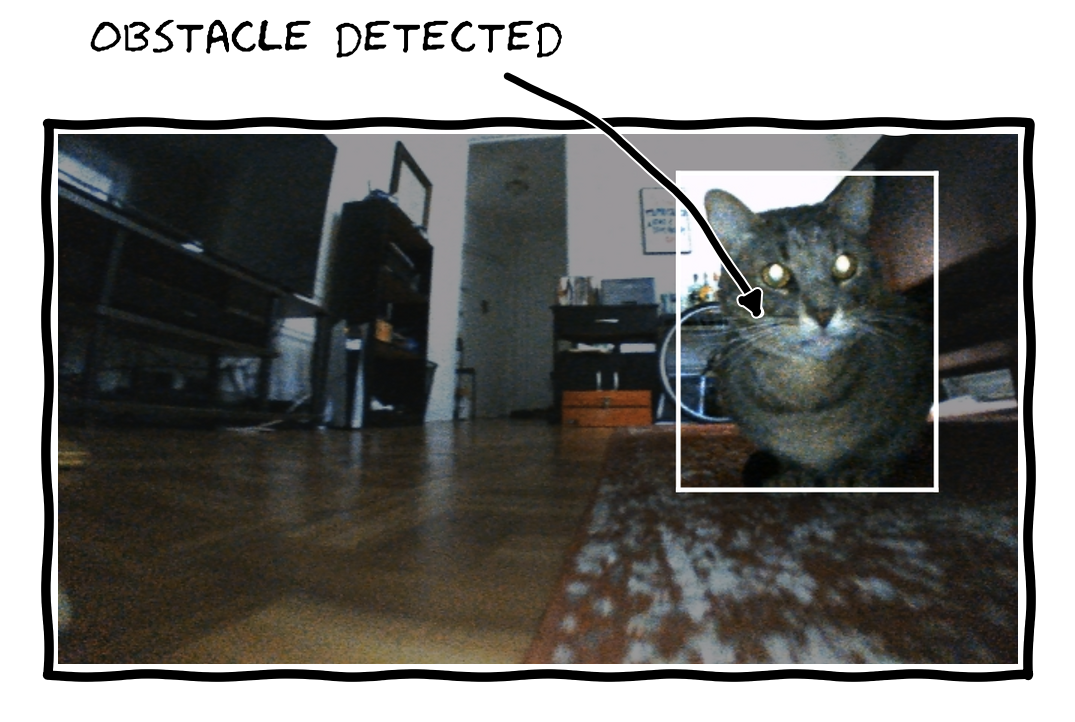
A cat, photographed by a Roomba. The robots that made money skipped the intelligence.
Brooks also has the better explanation for why the industry over-promises, in two laws that fit it better than its own press releases do. First: when a system performs one task well, observers immediately overestimate its competence at everything adjacent. Performance gets mistaken for competence. Second: a robot’s appearance is a promise it must keep or be rejected, which makes the humanoid form itself a fundraising instrument, an implicit claim of human-level generality that no demo has cashed. Look at the industry through that lens and the pattern is hard to unsee. Companies whose customers are investors build human-shaped machines: Figure, 1X, Tesla. Companies whose customers are factory operators build alien ones. The production Atlas has a lamp for a head, bowed legs that bend both directions, joints with full rotation, exactly two unique actuator types to shrink the supply chain, and limbs a customer can swap in five minutes. Nobody watching it estimates its competence at anything but work. And Brooks carries a receipt for his timeline instincts: he co-invented loop closing, the core of SLAM, in 1985, then watched hundreds of researchers take twenty years to make it practical and thirty to make it cheap. His stated rule, when a lab demo is announced as two years from changing the world, is to laugh.
Sergey Levine runs the Berkeley lab behind much of modern robot learning, and the surprising part is how much of Brooks’s case he grants. Internet pretraining gives a robot knowledge and no competence; his framing is that watching tennis does not produce a tennis player. Every surrogate data source, simulation, video, teleoperation, gloves, connects to the real task through hand-built assumptions; he calls them sporks, and he applies the critique to his own company’s methods. Where he diverges is the conclusion. If competence comes from deployed experience, then the date that matters is not when robots are finished but when the fleet starts generating its own training data faster than the surrogates can. His stated median for autonomously run households is around 2030. Brooks says decades.
They agree touch matters, they agree current data is insufficient, they agree every surrogate has a ceiling, and the entire fight is a factor of ten on the date. Self-driving says a factor of ten is exactly the size of error this kind of forecast produced last time, and the error landed in the direction Brooks predicts.
The test is already running in public. 1X opened NEO preorders in late 2025 at 20,000 dollars, or 499 a month, with launch videos that were partly teleoperated and an early review featuring five unedited minutes of three dishes entering a dishwasher. Its Hayward factory, billed as America’s first vertically integrated humanoid plant, opened in May 2026, and the first units are reaching customer homes this summer. The company’s position is that the product is early and will improve through deployment, which is Levine’s argument converted into a shipping decision: pay the reputation cost now, collect household data no surrogate can produce, let the fleet close the gap. Watch the intervention rates on those machines over the next two years. Falling rates are the flywheel’s first humanoid evidence. Flat rates hand Brooks the verdict early.
who ends up owning the brain
Underneath the timeline fight sits a business-structure fight, and it turns on the same scarce resource. 1X builds NEO’s body, trains its brain, and keeps its data. Figure and Tesla run the same vertical play: one company holding all three, on the theory that they compound. The opposing camp sells the brain by itself. Physical Intelligence open-sourced pi-0’s weights and training code in early 2025, with recipes showing that 1 to 20 hours of data adapts it to a new robot and task. Skild AI compresses its whole pitch to any robot, any task, one brain: a foundation model pretrained on simulation and human video, running on hardware from 4,000 to 15,000 dollars in place of quarter-million-dollar custom cells, licensed to ABB, Universal Robots, MiR, and Foxconn, and funded in early 2026 with 1.4 billion dollars at a valuation above 14 billion. The wager underneath is that robot hardware fragments into thousands of body types from hundreds of makers, and a brain that mounts on all of them ends up worth more than any single body.
Both camps cite the same precedent: phones. Apple kept hardware and operating system together. Google bought Android for about 50 million dollars in 2005, licensed it to everyone, and Android now runs about 72 percent of the world’s phones. Both strategies produced giants; they captured different layers, Apple the profit and Android the installed base and the data flowing through it. For robots, the fleet arithmetic from earlier decides the stakes. If deployed experience is the scarce input, then the union of every licensee’s fleet outweighs the largest vertical fleet, and the brain vendor harvests it without ever building a robot.
Cross-embodiment transfer works in demos and is unproven at production reliability, and the analysts who lay out Skild’s thesis note that a model looking general on stage may still need months of site-specific engineering per deployment, which converts a software company back into an integrator with worse margins. The vertical camp’s best evidence is physical: the 1,000 Hz balance controller is trained for one specific body, and a licensed generalist brain guarantees nothing about the low-level control keeping 60 kilograms safe around people.
Two researchers recently gave the larger moment a name: robotics has entered its first shared paradigm, driven by a hardware collapse and an architecture collapse arriving together. Unitree cut quadruped prices about thirty-fold in 2021, ending the era of lab-built robots; a research cell that cost 62,000 inflation-adjusted dollars in 2016 is outpriced today by four base-model humanoids. Meanwhile the bitter lesson, scaling laws, and behavior cloning became the scaffold every lab shares. Historically, a paradigm plus commodity hardware is the precondition for outsiders participating, and one side effect is already visible: academic labs, priced out of industrial-scale data collection, are migrating to evaluation, deployment studies, and theory, which happens to be exactly where the scoreboard problem says the field is starving. Open weights end up carrying two loads at once: the commoditization strategy, and the only working audit the field has.
the 1,288-dollar experiment
The number from the computer section comes back here. Under the 20,000-dollar humanoids and the 30-dollar-an-hour rentals, a third category started shipping this year, and it is the most interesting one per dollar.
Nori Robotics opened orders for the L2, a meter-tall two-armed wheeled robot, at 1,288 dollars, shipping this summer. BracketBot sells a tall wheeled manipulator for under 3,000, with founders who talk about a billion units. Weave’s Isaac 1 is a full home mobile manipulator at 8,000 dollars, or 450 a month, and the deployed units of its clothes-folding predecessor already fold more than a thousand pounds of laundry a week. The prices come from a consistent set of refusals. Wheels instead of legs, so no millisecond balance loop and no stair-climbing safety case. The brain in the cloud on a thin client, which wheels permit, because a statically stable machine can stop and wait out a network failure. Plain grippers with wrist cameras instead of tactile hands. A fixed head. The makers state the trade themselves: no stairs, no top shelves, in exchange for appliance pricing.
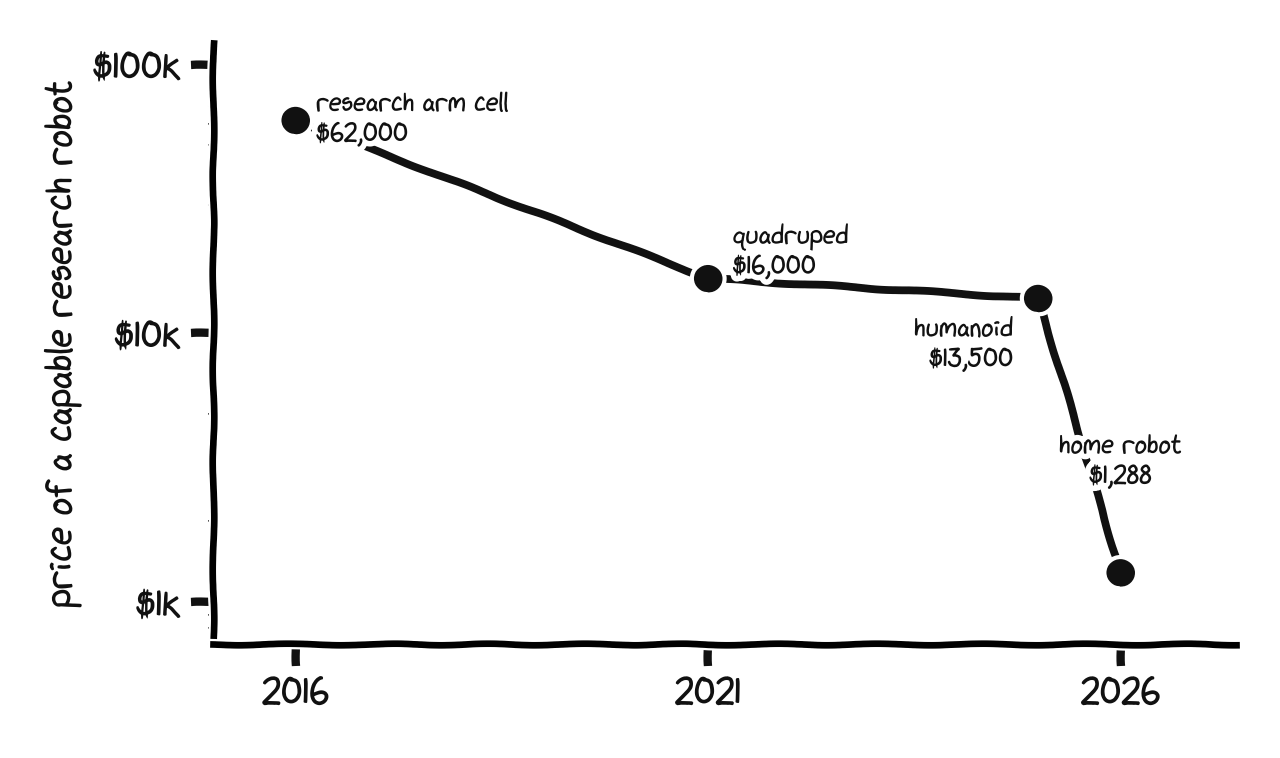
A capable research robot, one decade of prices. The 2026 entry costs less than a phone.
The cheap machines run two experiments the premium ones cannot. The first is on the humanoid form itself. The engineering case for a humanoid reduces to the case for legs, and the recorded answers are two: terrain, and heavy payloads in tight footprints. Terrain is rarely decisive; when Amazon’s wheeled drive units struggled, the company re-graded its warehouse floors flatter rather than buy legged robots. The payload case is real and does not require the machine to look like a person. The cheap-robot designers took the opposite branch at every fork, landed two hundred times below a premium humanoid’s price, and turned “does that machine do enough at that price” from a panel discussion into a market question.
The second experiment is about who gets to contribute data at all. The first internet was written by millions of unpaid people on commodity hardware. Robot data has never had an amateur contributor class, because entry cost 62,000 dollars. A 1,288-dollar robot, plus open weights, plus a shared training recipe, is the amateur kit, and the field’s evaluators have noticed: the researcher who ran Meta’s home-robot benchmark now says he would rerun it on sub-2,500-dollar hardware with home-testing rules so that anyone could enter.
This camp’s end state has a name, a Cambrian explosion: many robot species assembled from shared actuators and a shared brain, instead of one humanoid form deployed everywhere. LimX’s TRON2, a machine that reconfigures between wheeled and bipedal, is the existing prototype, and the camp states its own failure conditions, which is more than most camps do: contact simulation staying intractable, or in-domain data proving too important for shared brains to cover.
One warning belongs permanently next to the price tag. A thin-client robot is hardware you own running a mind you rent, and the subscription has a remote off switch. At 1,288 dollars, the mind is most of the machine. The terms-of-service governance that runs through the rest of this industry applies, in your kitchen, to a robot that goes inert when the company pivots.
what more data cannot buy
Suppose the pipeline works. Say a robot finally folded the laundry, in your house, yesterday. What does the robot remember about it today?
The honest inventory is short. It retains a context window covering the last few minutes of sensor input, plus network weights shared with the whole fleet and updated on the company’s schedule. Between those two, in the place where what this robot learned in this house would live, there is no standard component at all. Unless yesterday’s episode gets selected for a future fleet-wide training run, it is gone. And the gap shows up in behavior: deployed vision-language-action models measurably degrade on any task needing even short-term memory. The clearest symptom is the repeated failed grasp of an unfamiliar object, where remembering the previous attempt would change the next one, and the model does not remember it.
Fine-tuning each robot on its own household has been blocked since the 1980s by catastrophic forgetting. Gradient updates have no respect for prior knowledge. Training a network on your dishwasher measurably damages what it knew about dishwashers in general, sometimes about unrelated skills, and no reliable audit exists for finding out what was lost. Production fleets therefore forbid per-robot weight updates outright, and personalization means stuffing notes into the context window and querying a database, which imitates memory without ever changing the weights. Thirty years of continual-learning research has not produced a fix, and embodiment just converted the research problem into a commercial one, because a home robot that cannot keep private experience re-learns your kitchen every morning.
The labor arrangement this produces has no analog in human work. At the fleet level, nothing is ever lost: one robot’s failure ships as a correction to every robot in the next update. At the individual level, nothing is ever kept: every unit wakes from every update identical to its siblings, expert in everything the fleet has ever seen, blank about the one building it works in. Amazon’s floor leaks 3 percent of its accumulated skill out the door every week. A fleet leaks none and holds none locally. Nobody has built the version that does both.
Memory is the first missing component. The second is doubt, and the intervention economy runs on it. A robot that asks for help at the right moments is the entire difference between Waymo’s one operator per 43 vehicles and a humanoid deployment quietly employing a shadow workforce. Ask too rarely and the failures are dangerous. Ask every forty seconds and the margin is gone. Neural networks are miscalibrated in both directions, and the root cause is familiar by now: nothing in demonstration data ever shows a model its own ignorance, because demonstrators do not demonstrate confusion. The San Francisco outage adds the fleet-scale version of the problem. Uncertainty handled by a shared brain fails correlated, every machine hitting the same wall in the same minute, and calibration for fleets is not yet even a well-posed research problem.
The third component is newer to the list, and unlike the other two it gets worse with scale. A foundation-model policy is nondeterministic inference over a learned distribution. When a hand-coded cell fails, an integrator reads the logic, finds the branch, and fixes it. When a policy fails, nobody can say why. Follow that inability down the chain: downtime cannot be diagnosed, so an uptime commitment cannot be honestly underwritten, so the service agreement that industrial customers require gets signed as a bet or not at all. Interpretability gets discussed as a safety virtue. At deployment it is a line item, and every step toward bigger end-to-end models, the direction the entire data pipeline points, raises it.
Memory, calibration, interpretability. More teleoperation hours fix none of them. A bigger fleet fixes none of them. The third, scale actively worsens. The industry is building, at billion-dollar cost, a machine for delivering experience to learners that cannot retain it privately, cannot doubt their own conclusions, and cannot explain their failures, and the people building the pipeline mostly do not claim otherwise. I have looked for a published plan that closes any of the three. I have not found one.
the market on the other side
Suppose all three get solved anyway. The market waiting on the other side is not the one in the pitch decks.
Across most of the economy, a general-purpose robot competes against neither fixed automation nor human labor. It competes against nothing: the standing decision to automate nothing at all. Survey small manufacturers about why, and the same reasons repeat. A prior deployment that failed and salted the ground. A 50,000-dollar robot losing the budget fight to a 50,000-dollar machine tool that opens new revenue. Integration across PLCs, safety systems, and undocumented software in three languages. No universal end-effector, so every job needs custom tooling. Parts presentation as a bespoke art, every time. An electrical panel nobody on staff can service. Nike ran the cleanest version of the experiment: it near-shored shoe production from Vietnam to Guadalajara on heavy automation, and the facility closed, because stitching and gluing high-variety soft goods is exactly the deformable, contact-rich regime that simulation cannot render and no dataset covers. Shoes are still made by hand. At the opposite pole, FANUC’s dark factory has assembled a robot every 80 seconds since 2001, and the qualifier carries all the weight: millions of identical units, every motion choreographed months in advance.
Between those poles sits the humanoid’s actual addressable market, the middle that fixed automation never touched: high-mix, low-volume, soft goods, small-shop work, plus the unstructured halves of warehouses and homes. It is also the data map from the first half of this essay. The territory the market never reached coincides, cause for cause, with the territory where manipulation data does not exist. The work is irregular, deformable, and contact-rich, which is simultaneously why no machine was ever economical there and why its data was never generated. It is one gap, seen once from the market side and once from the data side. Read optimistically, solving the data problem unlocks the entire territory at once. Read the other way, the territory has resisted machines for a century for reasons that run deeper than data, and the data famine is a symptom rather than the disease. Both readings survive the evidence so far.
The demand argument that outlasts every warehouse calculation comes, of all people, from Brooks, and it has held since 2017. Demographic inversion is not a projection. The number of 25-to-29-year-olds China will have in twenty years is bounded above by births that have already happened, at less than two-thirds of today’s cohort, and no policy reaches backward in time. Japan is 27 percent over age 65 against 15 in the United States, with deaths outrunning births 9.6 to 7.8 per thousand, and more than half of all countries are on the same curve. This is a different kind of claim from the warehouse story. Churn says labor is expensive to retain, which higher pay answers. Inversion says the labor will not exist, which nothing answers, because raises do not enlarge a birth cohort and every aging country is bidding for the same shrinking pool of migrants. It explains the geography of the production race, since China faces the steepest curve and builds hardest. And it names the deployment the industry avoids saying out loud: eldercare, unstructured homes, long-tail tasks, the one setting where re-engineering the environment is off the table, because the environment is a person’s house. The honest boundary of the argument is that demographics guarantee demand for machine labor, not for this form of it. Japan met its own inversion with the densest single-purpose robot adoption on earth.
The bill for all of this has entries the launch videos omit. Brookfield’s arrangement records daily life at home in order to train machines, a fleet with a shared brain is a camera network with perfect recall, and the footage is governed by terms of service rather than law, terms that reach further on a thin client whose mind has a remote off switch. Liability is unassigned: when a policy shaped by a million homes damages something in yours, the fault routes through a training run no court has ever examined. The wage arbitrage funding the entire buildout aims, by construction, at the people currently earning the wage, and Amazon’s documented response at one site to complaints about robot pace was to replace the workers, not adjust the robots. And the architecture is already at war. FPV drones in Ukraine lock and pursue targets autonomously because jamming severs the pilot link and autonomy wins the countermeasure race, and startups now sell natural-language command of mixed ground and air robots against targets. Vision-language-action models. The same stack, a different payload, with the governance line drawn by vendor policy, which is the same instrument that governs the kitchen footage.
when
So: when. No single number answers it, because the unsolved problems separate into three queues that run on different clocks.
The first queue is sensor-blocked. Fingertip touch at three-gram resolution is shipping now. Smell and chemical sensing have no instrument, no dataset, and nothing on any roadmap that changes either. The second queue is data-blocked: the factories, the gloves, the portfolio recordings, the fleet learning. This is the queue you can actually watch move, because its growth rate reads directly off a production chart. The third queue is idea-blocked: continual learning, calibration, interpretable policies. There is no pipeline for ideas. They arrive when they arrive. Any single-number timeline for general-purpose robots averages these three queues together, and the average of a shipping date, a growth rate, and an unknown is not a date.
What you can do is apply the base rates the field itself has generated. SLAM took twenty years to reach practicality and thirty to reach ubiquity, with hundreds of researchers on a clean problem. Self-driving delivered its mechanism ten years behind its promises, through a winter that consumed Argo’s 3.6 billion dollars along the way. The humanoid pipeline is likewise financed years ahead of revenue, so a winter before a verdict is a standing possibility; the partial shelter this cycle is defense procurement, which is counter-cyclical and indifferent to commercial timelines, and which protects autonomy and perception work but not household manipulation. Those rates translate the Brooks-Levine disagreement directly: Levine’s 2030 reads as mid-to-late 2030s. Brooks’s decades reads as decades, not never.
The first internet accumulated over thirty years, as a byproduct, because talking is free. The second one is being assembled deliberately, at industrial cost, and you can now watch it grow: a factory adding a robot an hour, five hundred gloved hands working for wages, a hundred thousand instrumented homes, amateurs arriving the moment 1,288-dollar hardware met open weights, and the most valuable pages of all, the failures, collected on purpose by fleets sized specifically to encounter them. The two-year-old from the first paragraph still holds more embodied experience than all of it combined. She stopped accumulating at that rate around the time she learned to talk. The pipeline does not stop.
Sources: the SemiAnalysis report Robotics Levels of Autonomy (2025) for warehouse turnover, loaded wages, exclusion lists, and the 2015-2022 picking history; Figure’s engineering posts on BotQ, Helix, Helix 02, and Project Go-Big, with production reporting from Humanoids Daily and The Robot Report; NVIDIA’s Jetson Thor specifications and Newton engine documentation; Google DeepMind’s RT-2 paper; Physical Intelligence on pi-0, the openpi release, and the Recap results; Skild AI’s technical blog and 2026 funding coverage; Rodney Brooks at rodneybrooks.com: Why Today’s Humanoids Won’t Learn Dexterity (2025), Parallels Between Generative AI and Humanoid Robots (2025), Deployment at Scale Takes Decades (2025), Megatrend: The Demographic Inversion (2017), Research Needed on Robot Hands (2017), and the annual Predictions Scorecards; Chris Paxton at It Can Think: Rise of the Cheap Robots, The State of the Self-Driving Car in 2026, How to Fake a Robotics Result, How Do We Quantify Progress in Robotics, What Do Robotics Leaderboards Tell Us, Will World Models Allow Robots to Think, Building a Home Robot with Zero Robot Data, The Case for a Robotic Cambrian Explosion, How Human Should Your Humanoid Be, Why Not Everything Is Automated in Manufacturing, Automating the Kill Chain, and Why Are Left and Right So Hard for LLMs, plus Capability vs. Deployability with Gabriele Tinelli and The First Paradigm in Robotics and AI Research with Avik De; Russ Tedrake’s Underactuated Robotics notes for the ASIMO cost-of-transport and passive-walker material; Sergey Levine’s The Promise of Generalist Robotic Policies and Sporks of AGI and his 2025 interviews; Sunday Robotics Series B coverage; Boston Dynamics Atlas product materials; Waymo remote-operations reporting and coverage of the December 2025 San Francisco outage; BYD God’s Eye and Wayve deployment reporting; 1X’s NEO launch materials and early reviews; Agility Robotics’ certification and pricing announcements; Hans Moravec, Mind Children (1988); the instrumented tactile corpus and Wan video-VAE papers on arXiv; Pinto and Gupta (2015); Andrej Karpathy, Software 2.0 (2017); Acemoglu and Restrepo, Power and Progress (2023).